


University Assistant Professor
PhD Opportunities
We welcome motivated and creative candidates interested in joining the Dydio Lab to pursue a PhD starting in October 2027. For further information about available projects and application procedures, please contact pd552@cam.ac.uk.
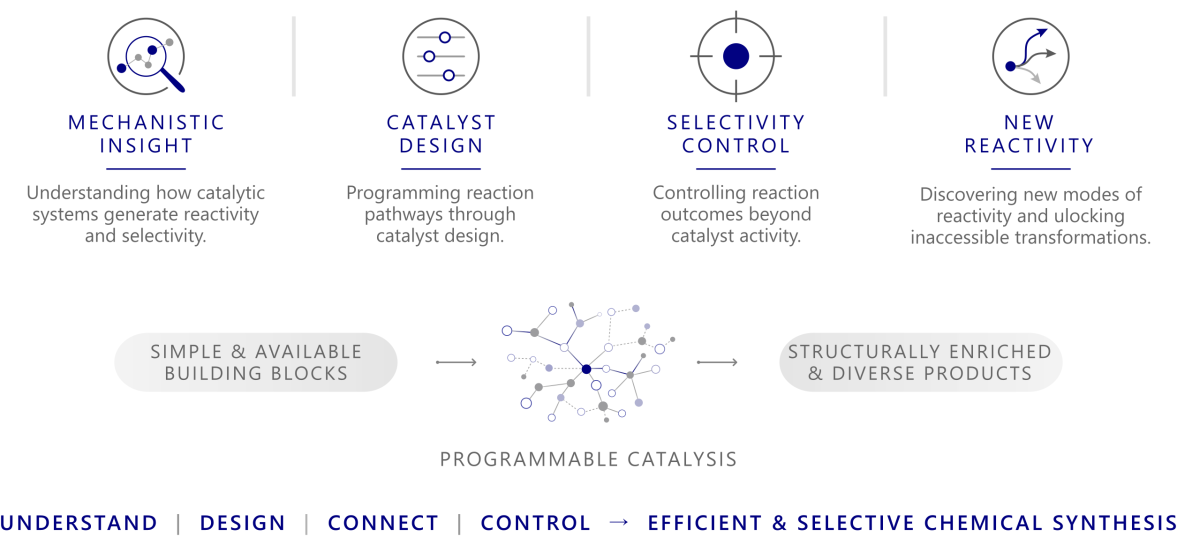
Our research seeks to understand how catalytic systems generate reactivity and selectivity, and to use this understanding to develop new reactions and more efficient approaches to chemical synthesis. We are particularly interested in transformations whose outcomes cannot be controlled simply by identifying a more active catalyst. Instead, we investigate how catalyst structure, reaction pathways, intermediates, reversible processes and competing elementary steps collectively determine the behaviour of the overall system.
By combining mechanistic investigation with catalyst and reaction design, we aim to uncover new modes of reactivity, achieve more precise control of selectivity and move beyond the optimisation of individual catalytic cycles towards deliberate control of the wider reaction systems in which they operate.
A central objective of our research is to convert simple and readily available starting materials into structurally diverse and valuable products under mild and selective conditions. We therefore study both individual catalytic transformations and more complex systems in which several pathways interact. This allows us to address complementary challenges: creating reactivity where conventional methods are ineffective, controlling selectivity in established processes, and using interconnected catalytic reactions to access outcomes that cannot be achieved through a single catalytic cycle.
Multicatalysis & Catalytic Reaction Networks
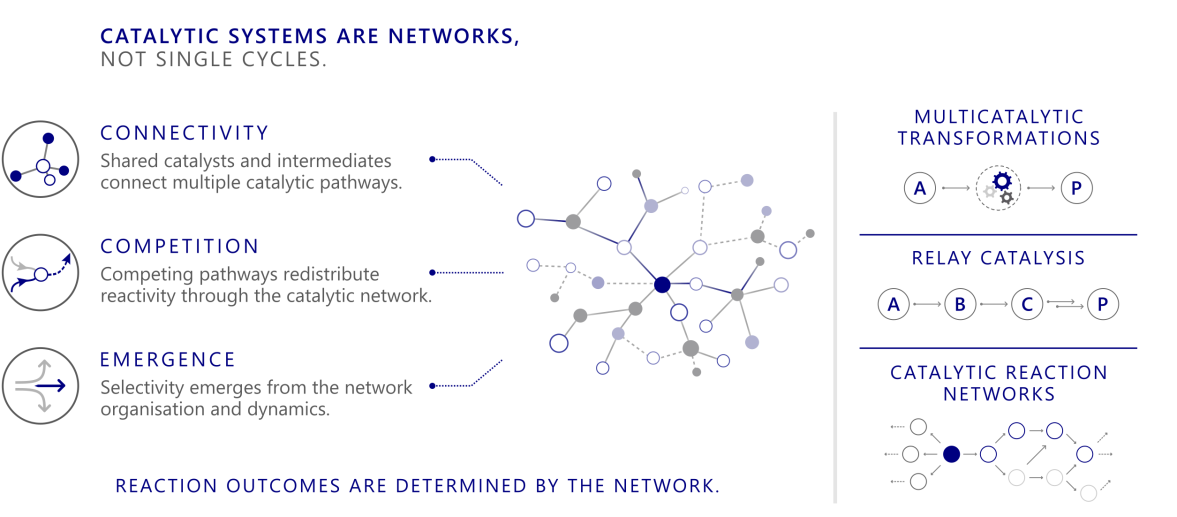
Catalytic reactions are often represented as individual catalytic cycles leading from a substrate to a product. In practice, however, catalytic systems may contain multiple interconnected processes involving catalysts, intermediates, reversible transformations and competing pathways.
We investigate how such systems can be deliberately constructed and controlled. Our central interest is in catalytic reaction networks in which several pathways operate simultaneously and compete for shared substrates or intermediates. In these systems, the product distribution may be determined not only by the intrinsic selectivity of an individual catalyst, but also by the relative rates and connectivity of reactions across the entire network. This approach creates opportunities to access transformations that are difficult to achieve through a single catalytic cycle. It can enable the functionalisation of otherwise unreactive molecular positions, redirect established reactivity and provide divergent access to different products from common starting materials by changing how the catalytic system operates.
Our work has demonstrated these principles through multicatalytic and relay-catalytic transformations of alcohols and amines, dynamic kinetic resolution integrated with relay catalysis, and responsive networks of interconnected catalytic reactions. Our long-term ambition is to understand how the organisation and dynamics of interconnected catalytic pathways determine reaction outcomes, and to use this understanding to achieve greater control over chemical synthesis.
New Catalytic Reactivity
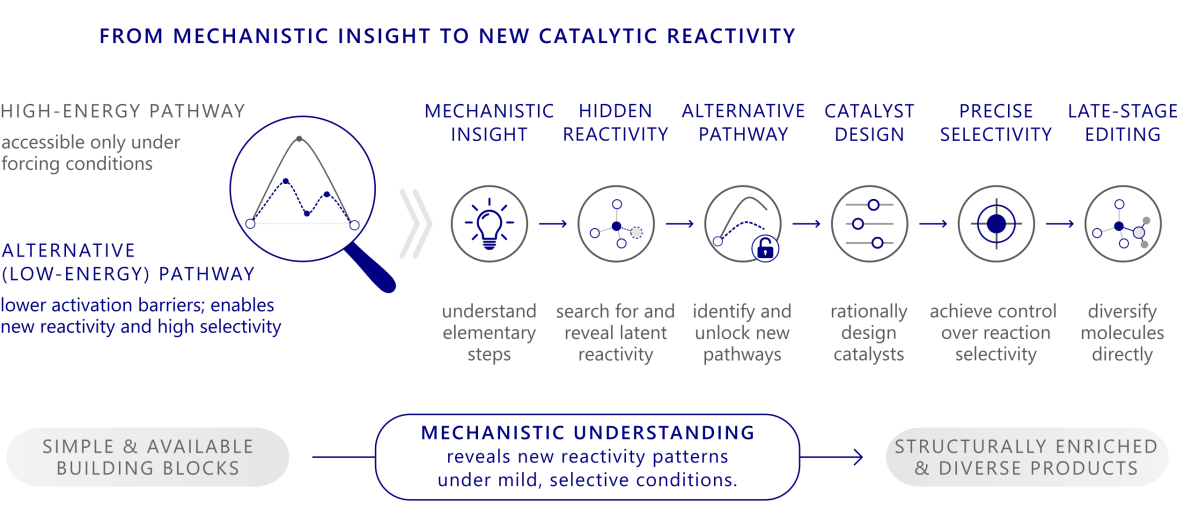
Many readily available molecules are difficult to modify selectively. The most useful positions for their diversification may contain strong, unactivated bonds or may be surrounded by several chemically similar sites.
One common way to overcome limited reactivity is to use highly reactive reagents, elevated temperatures or other forcing conditions. However, such conditions often reduce the general utility of a method because sensitive substrates may undergo competing reactions, lose functional-group integrity or decompose. We therefore seek catalytic strategies that provide precise reactivity under mild conditions. Rather than relying on forcing conditions, we use mechanistic reasoning and detailed insight into elementary reaction steps to identify alternative pathways and design transformations that are difficult to achieve through conventional approaches. A recurring objective is to convert common functional groups and readily available starting materials into versatile synthetic intermediates while maintaining broad functional-group compatibility. Representative examples from our work include transfer C–H borylation of alkenes and the decarboxylative functionalisation of aromatic carboxylic acids.
We are also interested in selective late-stage functionalisation. Such reactions can enable existing molecules to be diversified directly, reducing the need to redesign and repeat their entire synthesis. Across these projects, mechanistic studies are used not only to explain observed reactivity, but also to identify new transformations and guide catalyst and reaction design. Our broader ambition is to uncover new catalytic reactivity that operates selectively under mild conditions and to extend these concepts towards the functionalisation and diversification of increasingly complex molecules.
New Selectivity Control
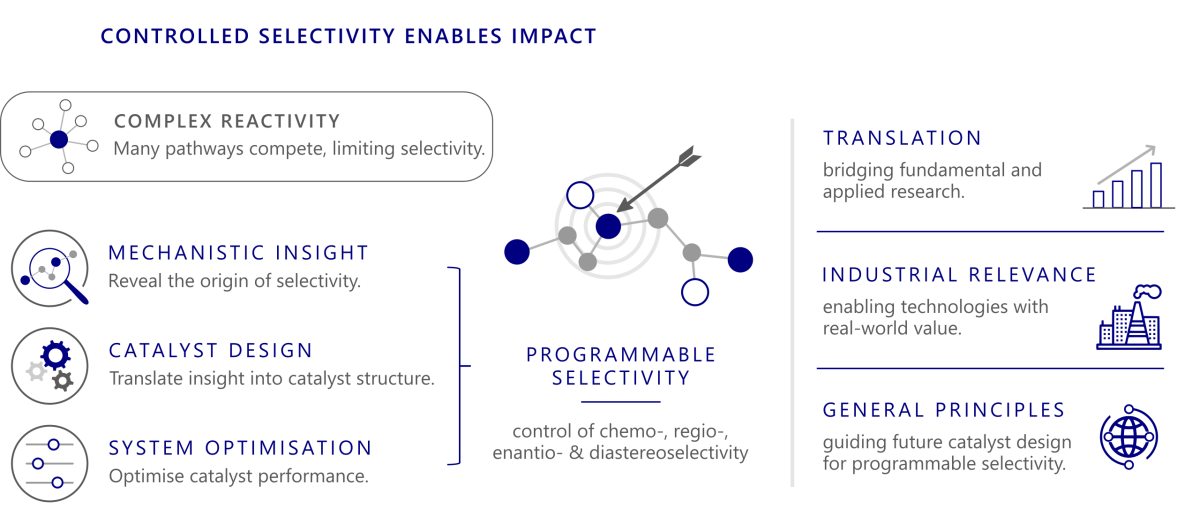
Many established catalytic processes are highly attractive because they convert simple and readily available starting materials into valuable products. However, their broader synthetic potential is often restricted by incomplete control over competing reaction pathways and, consequently, over chemo-, regio-, enantio- and diastereoselectivity. We seek to develop a mechanistic understanding of such important processes and use it to address their fundamental limitations. By identifying how catalyst structure, speciation and elementary reactivity determine the outcome of a reaction, we aim to design catalytic systems in which selectivity can be controlled deliberately and, ultimately, divergently.
Carbonylation chemistry provides a particularly attractive model for this approach. Carbonylation reactions can combine simple alkenes, carbon monoxide, hydrogen and suitable nucleophiles, including alcohols, amines, thiols and water, to access aldehydes, esters, amides, thioesters and carboxylic acids. These reactions are highly atom-efficient and synthetically versatile, but their full potential depends on the ability to control which product is formed, where functionalisation occurs and which stereoisomer is obtained. Our work on palladium catalysis has shown that mechanistic insight, catalyst speciation and ligand design can generate selectivity patterns that are difficult to achieve using established carbonylation systems. This includes iodide-assisted palladium catalysis for selective hydroformylation, isoselective hydroformylation of simple aliphatic alkenes, and regio- and enantioselective alkoxycarbonylation of unactivated terminal alkenes.
These studies connect fundamental organometallic chemistry with the development of synthetically and industrially relevant processes. Our broader ambition is to establish general principles for controlling selectivity in catalytic reactions, enabling divergent access to structurally distinct products from common and simple starting materials. Selected developments arising from this research have been protected through patent applications and are being advanced through translational research with industrial partners.
See the Dydio Lab website for further details and representative publications.
Watch Dr Dydio discuss his research
Publications
- ‹ previous
- Page 2
